
During my Churchill Fellowship research visit to Vancouver, I visited the Japanese Canadian War Memorial in Stanley Park in December.
The memorial itself is modest in scale: a stone column topped by a lantern.
Erected in 1920 by the Japanese Canadian community, the memorial honours those who served in the First World War. Men who volunteered for a country that did not yet fully recognise them as equal citizens. Fifty-four Japanese Canadians were killed in that conflict. Their names are recorded here with quiet dignity.
What gives the memorial its deeper resonance, however, is not only whom it commemorates, but what happened afterward.

During the Second World War, following the attack on Pearl Harbor, Japanese Canadians were forcibly removed from the coast of British Columbia. Families were interned, property was confiscated, livelihoods destroyed. In that climate of fear and racialised suspicion, the lantern at the top of this memorial was extinguished.It remained unlit for more than forty years.
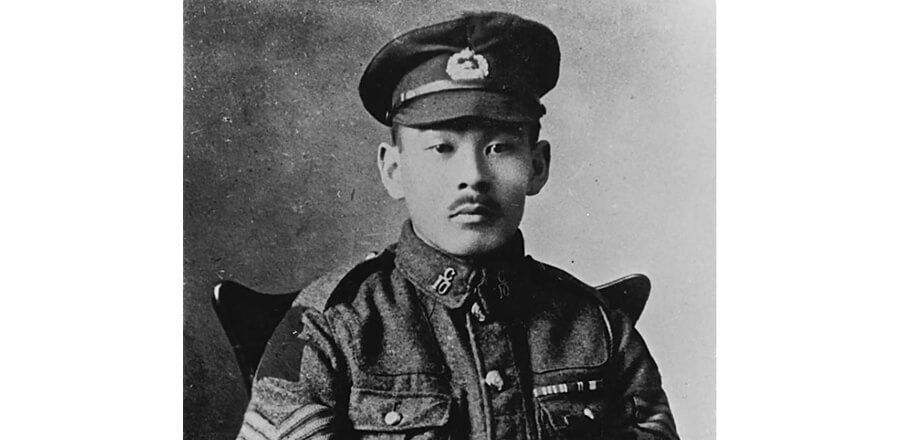
Masumi Mitsui, M.M.
In 1985, the lantern was relit by Sergeant Masumi Mitsui, himself a First World War veteran and one of the men the memorial honours. By then, he had lived through service, rejection, decades of silence, and eventual acknowledgment. The relighting of the lantern was not simply ceremonial; it was an act of moral repair.
For many veterans, this mirrors the experience of life after service. The focus is often on the moment of sacrifice: the uniform, the deployment, the medal. Meanwhile, the longer, quieter work of return, identity, and recovery is left largely unexamined.
As my Fellowship explores how learning and performing stand-up comedy can support veteran recovery, this site held particular significance. Comedy, when done honestly, can act as a form of relighting: bringing experiences that have been buried or misunderstood back into the open, allowing them to be acknowledged without being diminished.
The work of recovery, whether through comedy, community, or creative expression, is about finding ways to bring light back to those experiences. Not to glorify them or fix them, but simply to illuminate them enough that they can be
seen, understood, and integrated into a life that continues forward.
The Japanese Canadian War Memorial stands as a testament to service, yes. But more than that, it testifies to resilience, to the possibility of repair, and to the importance of finally, eventually, getting it right. Even if it takes forty years.
 Churchill Sent Me & A Bump in the road
Leave a comment