Finding the Funny: Inside Stand Up for Mental Health Vancouver

There’s something extraordinary that happens in a Vancouver comedy workshop when someone takes their deepest struggles, reshapes them with humor, and shares them with a room full of strangers. It’s not just entertainment. It’s transformation.
During my time observing Stand Up for Mental Health (SUFMH) Vancouver, facilitated by David Granirer, I witnessed something profound: people reclaiming power over the stories that have shaped them, often painfully. When participants craft jokes from their mental health experiences, they’re turning wounds into wisdom, isolation into connection, and vulnerability into strength.
What is Stand Up for Mental Health?
Stand Up for Mental Health is a program that teaches people with mental health issues how to do stand-up comedy. Under David Granirer’s facilitation, participants learn to transform their experiences with mental illness into comedy material, culminating in a final showcase performance where they take the stage before a live audience.
But this isn’t just a comedy class. It’s a unique form of therapy, empowerment, and community-building rolled into one.
The Alchemy of Crafting Comedy

Watching David work with participants, I observed how writing a joke requires something most therapeutic processes don’t: you have to find the angle that makes it funny. This isn’t about dismissing or minimizing experiences. It’s about examining them from every side until you discover a new perspective, one that gives you distance, control, and often, surprising insight.
The process of writing, rehearsing, and performing forces a complete re-examination of past events. Participants aren’t just remembering what happened; they’re actively reshaping their relationship to it. As Participant C reflected: “I do have a contingent self-esteem because I learned very young that connection and acceptance have to be earned. So that’s really perfect for performing.”
This moment of recognition, seeing how past wounds connect to present purpose, is where meaning-making happens. The comedy becomes the bridge between then and now, transforming something that once caused pain into something that creates connection.
From Isolation to Connection
Mental health struggles can be profoundly isolating. But in David’s workshop, when participants share their stories through comedy, something magical happens: people laugh. Not at them, but with them. They recognize themselves in each other’s experiences.
Participant A explicitly stated her goal as “connecting with people.” The comedy becomes a vehicle to bridge the gap between internal experience and audience, proving that what felt unshareable is actually deeply relatable. That laughter isn’t just entertainment. It’s recognition, acceptance, and validation.
Taking Back Control
Perhaps the most powerful aspect of SUFMH is the agency it provides. By writing their own jokes, participants control their narratives. They decide what to share, how to frame it, and when to deliver the punchline. This is revolutionary for people whose mental health challenges may have made them feel powerless.
I witnessed the meta-comedy of one participant joking about forgetting to write their ADHD jokes because of their ADHD. There’s agency in that moment, turning the very symptom that challenges you into material you control. You’re not at the mercy of your condition; you’re in dialogue with it, and you’re setting the terms.
Building Real Skills, Real Confidence
David doesn’t just provide catharsis. He teaches concrete skills. I observed participants learning joke structure, stage presence, and techniques for managing performance anxiety. He offers tangible tools which empower participants to handle difficult situations independently.
These skills extend far beyond the stage. The confidence that comes from structuring a compelling narrative, commanding attention, and handling the vulnerability of public speaking transfers to countless other areas of life.
The Power of the Spotlight
The final showcase is the ultimate act of empowerment. Standing on stage, delivering your set, and hearing the audience laugh. It’s transformative. Participants take material drawn from personal pain and successfully transform it into joy for others. That’s not just resilience; that’s mastery.
Participant A’s memory says it all: feeling “amazing” after her best set. That feeling is earned. It comes from doing something genuinely difficult, from being vulnerable and skilled simultaneously, from turning trauma into triumph.
What I Learned as an Observer
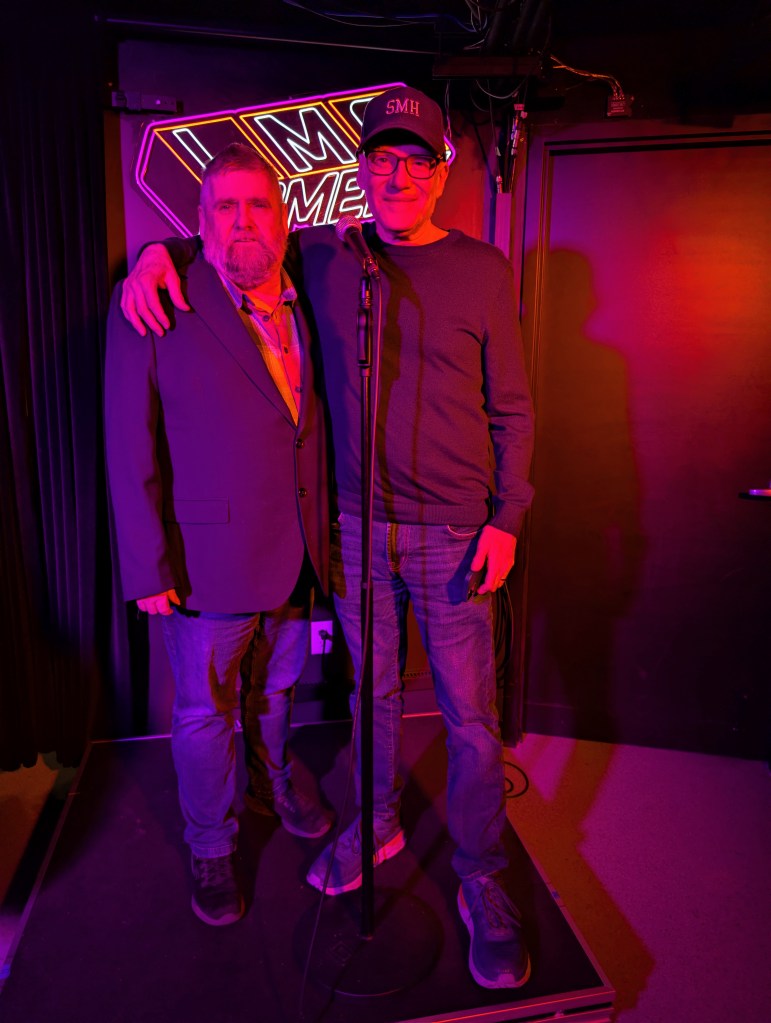
Watching David Granirer facilitate Stand Up for Mental Health revealed that this program isn’t therapy with jokes sprinkled in. It’s a unique form of meaning-making that combines creativity, vulnerability, skill-building, and connection. It’s proof that our struggles don’t have to define us, but they can inform us, connect us, and even empower us.
SUFMH gives people the tools to reshape their narratives through comedy, offering more than a coping mechanism. It offers a path to agency, connection, and genuine transformation. And sometimes, the bravest thing you can do is stand in the spotlight and make people laugh about the things that once made you cry.
Because that’s not just comedy. That’s healing with a punchline, and David Granirer has created a space in Vancouver where that healing happens every day.
 Churchill Sent Me & A Bump in the road
Leave a comment